
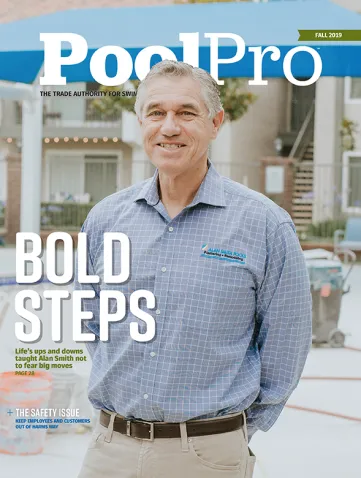
Alan Smith Pools: Forever a Pool Finisher
Work ethic, diversification and thinking ahead prime company for success
Photography By Tommy Ton
You don’t really know what work ethic looks like until you meet Alan Smith, CEO and co-owner of Alan Smith Pools in Orange, California.
Smith graduated high school early in 1974 and, on his own at 17 years old, went to work on a commercial fishing boat. After six months on the ocean, he realized that wasn’t a lifetime career path for him. A local pool plastering company was looking for help, so Smith showed up at 4:30 a.m., directly off the boat, looking for a job.
“He asked me a few questions, shook my hand and it was completely covered in calluses,” Smith says. “He was really impressed [that I was a commercial fisherman] and hired me on the spot.” By 5 a.m., Smith was on the job, working until late that evening. He says he was tired, worn down and beat up, but he showed up the next day. He was trained as a plaster mixer, learning everything he could. Within two years, Smith was a foreman.
The company did new construction, and it dawned on Smith that the pools they were building would eventually need new plaster. One February day, Smith was sitting on the edge of the pool with his other finisher, waiting for the scratch to dry.
The lady of the house brought them bacon and egg sandwiches and orange juice, and Smith had an epiphany: “I said, ‘Ya know, when we do new pools, we’re the last guys there, and the homeowner is usually so upset with the process they don’t like anybody. They barely talk to us. This lady was so glad to see us that she brought us sandwiches. Someday, we have to do nothing but re-plastering and get treated like this.’ ”
The Formative Years
In 1981, Smith acquired his contractor’s license, and he and his wife, Teresa, started Alan Smith Pool Plastering, focusing on the pool remodeling market. By 1987, Smith and a crew of eight were re-plastering upwards of 200 pools a year, working 16-hour days, seven days a week. Customer service started suffering, Smith says, so he hired Dave Huiberts — a 26-year-old who had his own pool service company — as his first salesman.
“My wife and I were quite apprehensive because we’d always worked for ourselves,” Huiberts says. “Alan gave me a lot of confidence that it would be a good deal. I’d never been a salesman before, but I sold 400 remodels the first year. As we were going into the second year, we were finding out that my forte was more in organization and [Smith’s] was in selling, so I became operations and he became sales. I’ve been organizing it ever since.”
Back then, Smith says, they didn’t have a lot of competition. They went to all the swimming pool supply and retail stores explaining what Alan Smith Pool Plastering did. Smith or Huiberts would visit these stores every month, developing relationships with the owners. “I started going to IPSSA meetings, the pool stores, the wholesale places, handing out cards and just putting a big emphasis on that,” Smith says. “It had an immediate impact.”


Hurdles to Overcome
While traveling in 2003, a friend noticed a growth on Smith’s neck. That led to a diagnosis of later-stage neck and throat cancer, which Smith battled for the better part of a year. He had a feeding tube and lost 65 pounds, but his work ethic remained intact. “I think I missed like two weeks of work during the whole process,” Smith says.
Smith beat cancer only to face the economic downturn in 2008. At the time, Alan Smith Pool Plastering was only doing plaster, tile and coping jobs, but “more and more people wanted one contractor to do everything,” Huiberts says.
Smith then completely changed his business model, including changing the company name from Alan Smith Pool Plastering to Alan Smith Pools. “I started about a year before [the downturn] in anticipation,” Smith says. “And sure enough, it came. We started having really good [potential employees] come on the market when other companies were closing. I was able to get top-notch people.”
Expecting his company would endure up to five years before the
economy got better, Smith depended on savings and business capital he’d built
into his preparation plan. “We
did so well [before the downturn] that we invested in the future,” Smith says.
Some years he broke even and others he lost some money, but he says it was
worth it.


Continued Growth
Smith says his business is much more sustainable now. He doesn’t do any more [residential] pools than he did back then, but he sold several million dollars in decking last year and $1 million in equipment. “Our business model changed and the complexity of our business changed,” he says, in part due to his expansion into the commercial sector in 2012. Kevin Kostka, who was hired in 2005 as head of water treatment, spearheaded the expansion. “It was maybe $100,000 to $200,000 a year in revenue at the time,” says Kostka, who is now the commercial division manager. “We just didn’t go after it before. We began to pursue the property managers, who might manage several pools, hotels, apartment complexes. And it’s a $6 million division now.”
Alan Smith Pools now has 120 employees, including six project managers, four division managers and an operations manager. Smith says 90% of the company’s business is within 45 minutes of its central hub, and it’s averaging about 700 projects a year. There’s a backlog of jobs waiting for them and up to 25 new leads each day, almost all residential referrals; Smith says he spent less than $5,000 last year on advertising. The company has done nearly 30,000 backyard remodels to date, which Smith attributes to those referrals and by working closely with local pool service companies.
The continued growth can also be attributed to the company’s commitment to always improve. “Each year we [focus our efforts and say], ‘This is the year of customer service,’ ” Kostka says. “One year was the year of efficiency, one year was the year of pavers, really going after that market.”
Kostka says the company’s recent focus was fixing communication problems, seeking to buck the preconceived notion that pool companies are bad communicators. To combat this, a few positions and departments were added.
“We got on the
kick of making sure that our customers knew daily what was going on,” Kostka
says. “And to get that
detailed really adds a lot of work, but it also adds quality to what we do.”


Pressing On
In the time since his cancer, Smith has also had two open-heart surgeries, and says that all of those close calls have made him bolder, willing to try anything. “I’m not afraid to embarrass myself,” he says. “I’ll give it my best shot, and it’s really enabled me to jump into big projects and do things far out of my comfort zone.”
To that end, Smith has spent the past several years working on philanthropic projects (see sidebar) and creating a strong culture built on trust and loyalty at Alan Smith Pools.
There is a feeling of family dynamic, teamwork and camaraderie. And it’s expected things will remain that way, even years from now. “This company is all set up to run without [Teresa and me],” Smith says. “They don’t really need us that much anymore. I still like being involved with everything. We’ll never retire — I’ll still always have my toe in the business — I’ll just do different stuff. I’m still a pool finisher. Next week I’m going to get in a pool and trowel with the boys. I feel like doing that now and then. I’m not as fast as I used to be, but I still have a few pools left in me.”
Giving Back

Since the early 2000s, Smith has been part of the development of Northrise University in Zambia. Smith started as a board member in charge of partnership and agricultural development. During the first two years of development, he traveled to Ndola, Zambia, seven times to develop Northrise Farms, a square mile agricultural farm built to help reduce the university’s operating costs as well as provide hands-on education for students. These days, the university has five facilities and Smith is in charge of development for the Agriculture and Engineering School. Find out more at northriseuniversity.com.
Smith has also had involvement at Cal Poly San Luis Obispo University. In the early 2000s, he was chair of the advisory board for the university’s environmental engineering department and helped start the national swimming pool industry research program there. Alan Smith Pools also built 12 pools and four spas on its campus.
Alan Smith Pools
Owner: Alan Smith
Location: Orange, California