
How Automatic Pool Covers Help Conserve Water During Droughts

Lighting has always been as much about feeling as function. With one change brewing behind the scenes at Pentair Pool, that feeling just got easier for pool pros to deliver.
Water conservation has become one of the most pressing issues facing homeowners, municipalities, and industries across the western United States and Canada. With drought conditions intensifying year over year, communities are being asked — and in some cases mandated — to reduce water consumption in every area of daily life. For the millions of households with swimming pools, that means rethinking how they manage one of their property’s most water-intensive features. The good news? One of the most effective solutions is already well-established: the automatic pool cover.
A Region Under Pressure
The western United States is in the grip of a prolonged drought crisis. Large portions of the region are experiencing what climatologists call “snow drought” — a condition in which snowpack levels fall dramatically below average, reducing the natural water reserves that communities depend on throughout the warmer months. The National Oceanic and Atmospheric Administration (NOAA) (1) has warned that drought conditions are expected to expand or worsen across much of the West, placing mounting pressure on water utilities, local governments, and individual consumers alike.
The consequences are already being felt. Water conservation policies are being enacted across the region, with restrictions targeting landscaping, outdoor water use, and pool management. In Phoenix, Arizona, for example, Phoenix Water Services actively encourages — and in some circumstances mandates — the use of pool covers as part of its drought response strategy, alongside restrictions on filling or refilling residential pools. Similar programs are emerging in cities and towns throughout California, Nevada, Colorado, and beyond, with some water utilities even offering rebates and financial incentives to homeowners who install automatic pool covers.
For pool professionals, this shifting landscape represents both a challenge and an opportunity. Staying ahead of potential water restrictions means proactively recommending solutions that help customers reduce consumption before mandates force the issue. At the top of that list is the automatic pool cover.

The Most Effective Tool for Pool Water Conservation
An uncovered swimming pool is a surprisingly significant source of water loss. Through evaporation alone, a typical residential pool can lose thousands of gallons of water each season — water that must be continuously topped off to maintain safe operating levels. During periods of drought and restriction, that ongoing demand becomes both costly and potentially prohibited.
Automatic pool covers address this problem directly and dramatically. When used consistently — meaning the cover is closed whenever the pool is not in active use — automatic covers have been shown to reduce water evaporation and water loss by anywhere from 70% to 95%. In practical terms, that translates to saving an average of 3,000 to 5,000 gallons of water per pool per summer. On larger pools, the savings are even more striking: a 2016 Cal Poly study(2) on evaporation found that an automatic pool cover saved approximately 900 gallons of water per month on a modest 11-by-20-foot pool compared to an uncovered pool of the same size. Scaled up to a 20-by-40-foot pool, that figure climbs to nearly 40,000 gallons saved annually — the equivalent of chemically treated, heated water that would otherwise simply evaporate into the air.
The scale of impact becomes even more significant when considered at the population level. A Santa Maria Times article reporting on the Cal Poly study noted that if pool covers were used on the more than one million pools in California alone, the water savings would be enough to supply a city of approximately 500,000 people with drinking water for an entire year. It is little wonder, then, that the U.S. Environmental Protection Agency (EPA)(3) recognizes pool covers as one of the most effective water conservation tools available to pool owners.
Beyond Water: A Full Spectrum of Savings
While water conservation has emerged as an increasingly urgent reason to install an automatic pool cover — particularly in western states — it is far from the only benefit. Pool professionals who understand the full value proposition of automatic covers are better equipped to make a compelling case to customers, regardless of the drought conditions in their region.
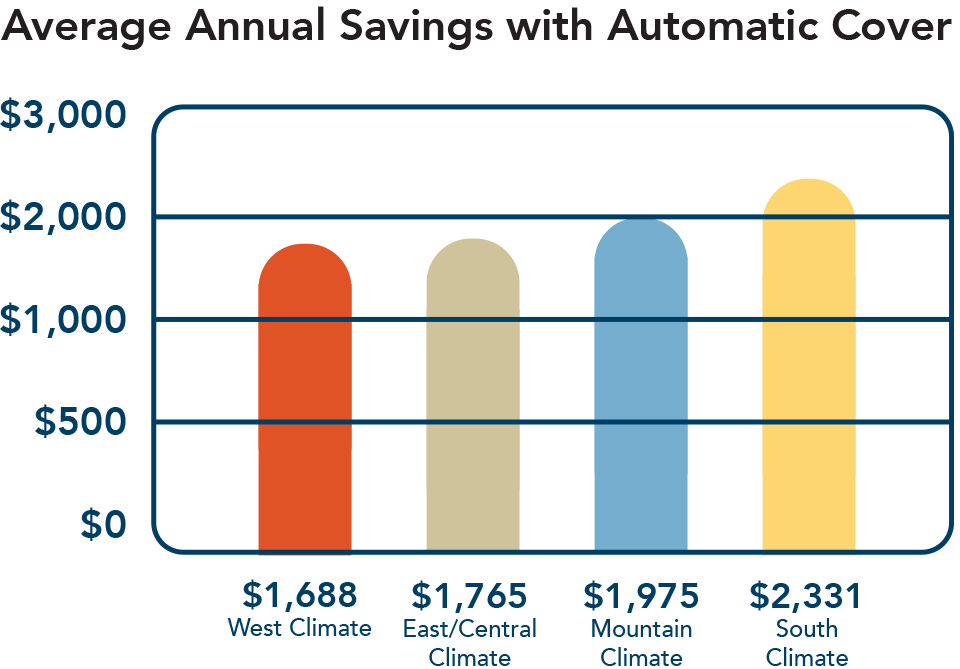
Heat retention is one of the most significant secondary benefits. When a pool is left uncovered overnight or during cooler periods, it loses substantial amounts of heat through evaporation. An automatic cover seals in that warmth, dramatically reducing the energy required to maintain comfortable water temperatures. Studies indicate that gas-heated pools equipped with automatic covers can save approximately $2,000 in heating costs per year, with some estimates from pool builders and service professionals citing total annual savings of $3,000 to $4,000 when compared to neighboring pools without covers. According to research referenced by the U.S. Department of Energy,(4) the return on investment is compelling: in some parts of the country, an automatic pool cover can pay for itself in as few as five years through energy, water, and chemical savings alone. Over a decade, that cumulative savings figure can exceed $40,000.
Chemical conservation is another underappreciated benefit. When pool water evaporates, it takes dissolved chemicals with it — chlorine, pH balancers, and other treatments that pool owners pay to maintain. By drastically reducing evaporation, an automatic cover keeps those chemicals in the water where they belong. Pool owners can reduce their chemical consumption by 35% to 60%, further lowering the operational cost of maintaining a clean, safe pool. Fewer chemicals also means less exposure to chemical-laden water vapor for bathers and surrounding landscapes.
Debris management rounds out the picture. An open pool is an open invitation for leaves, dust, insects, and other contaminants to find their way into the water, increasing the filtration load and the frequency of cleaning and chemical rebalancing required. A covered pool stays cleaner with less effort, reducing maintenance time and extending the useful life of filtration equipment.

Automation: Small Cost, Transformative Impact
It is worth noting that all of these savings come with an operational cost that is, by any measure, negligible. Opening and closing an automatic pool cover takes approximately 45 seconds. The annual energy cost to operate the cover — accounting for the electricity used to open and close it roughly 180 times over the course of a swimming season — amounts to less than $5 per year. No other single product added to a residential swimming pool offers a comparable ratio of investment to return.
The ease of use is also a critical factor in ensuring the cover’s conservation benefits are actually realized. Manual pool covers, however well-intentioned, are frequently left off because the effort of deploying them is too inconvenient. An automatic cover removes that friction entirely. With the press of a button, the pool is sealed — making it far more likely that owners will use the cover consistently and capture the full benefit of reduced evaporation and heat loss.
It is also worth acknowledging that automatic pool covers are not solely water conservation or energy efficiency tools. They were originally developed — and continue to be prominently marketed — as safety products. A properly installed automatic cover can prevent accidental drowning, a critical concern for families with young children or pets. The water and energy savings, substantial as they are, represent a secondary benefit to a product that also delivers significant peace of mind.

A Call to Action for Pool Professionals
For pool builders, service professionals, and retailers, the convergence of drought conditions, rising water restrictions, and growing consumer awareness around sustainability creates a compelling moment to lead with the automatic pool cover conversation. The product sells itself when the full picture is presented: safety, water conservation, energy savings, chemical reduction, and easier maintenance — all for an operational cost of a few dollars per year.
Educating customers about the real-world impact of pool covers should be a standard part of every consultation in drought-affected regions. When homeowners understand that their uncovered pool may be evaporating 10,000 gallons or more per year — water that must be replenished, treated, and heated again from scratch — the value of a cover becomes immediately tangible. Pair that with the prospect of utility rebates, potential regulatory mandates, and multi-thousand-dollar annual savings, and the conversation becomes straightforward.
Pool professionals who make it their practice to recommend automatic pool covers to every customer are not just selling a product. They are positioning their businesses as trusted advisors in an era when sustainability and resource stewardship are becoming central to how consumers evaluate the companies they hire. That reputation for proactive, responsible guidance is an asset that will only grow in value as drought conditions persist and water conservation policies continue to tighten across the West.

The Bottom Line
The message is simple: use a cover, reduce evaporation, and manage water smarter. In the face of expanding drought conditions, rising utility costs, and increasing regulatory pressure, the automatic pool cover stands out as one of the most practical and cost-effective investments a pool owner can make. For every pool professional who recommends one — and every homeowner who installs one — the result is a pool that is safer, cleaner, less expensive to operate, and significantly better for the environment. That is a case worth making, early and often.

Rick Larson
Rick Larson is the western regional sales manager for Automatic Pool Covers Inc., of Westfield, Ind. He has more than 20 years of experience in the pool and spa industry and is based in Colorado. He can be reached at rlarson@apc-mfg.com.