ADA Reality Check
Addressing accessibility requirements in aging commercial pools
Unlike fine wines, aging commercial pools don’t transition into a better version of themselves — unless owners and operators invest in upgrades, repairs and ADA compliance improvements that reasonably allow people of all abilities to use them.
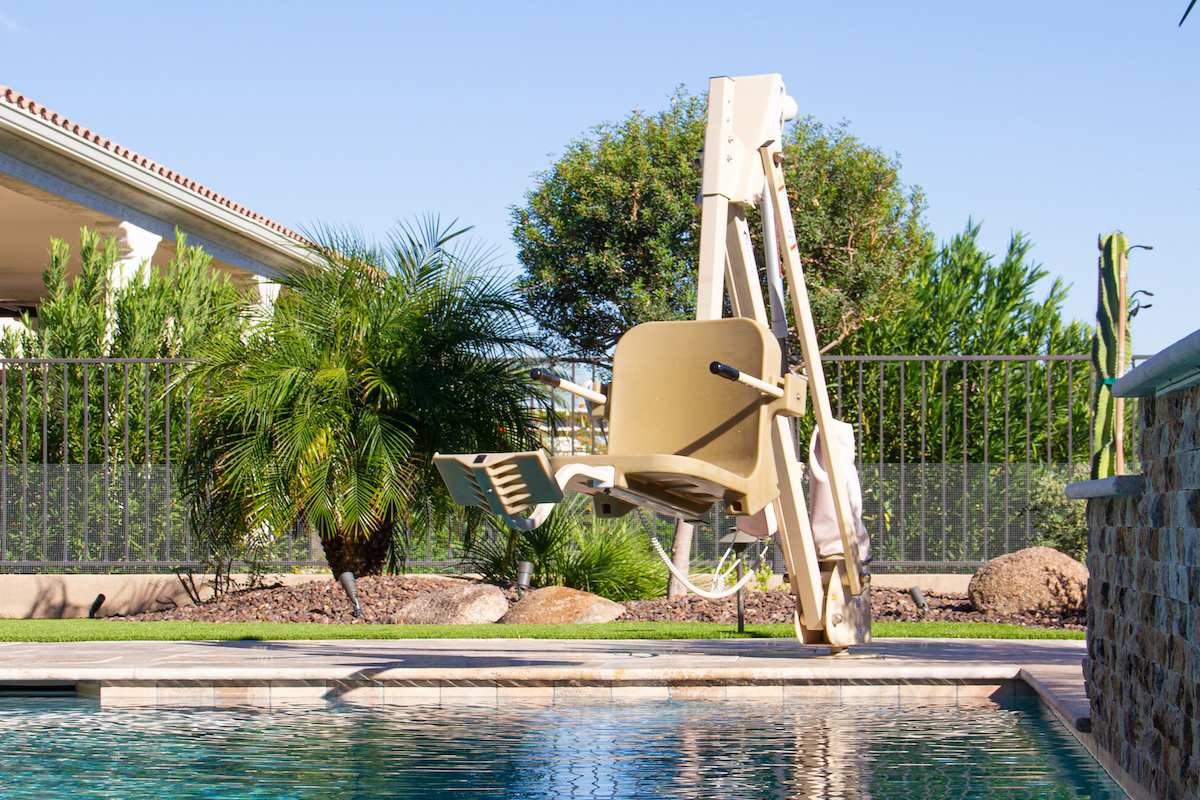
With few exceptions, the Americans with Disabilities Act requires aquatic facilities like hotels, recreation centers and HOAs to follow certain access regulations. Those standards have existed for more than a decade, applying to new pools beginning in 2012 and existing pools as of 2013. These include accessible entries such as chairlifts, sloped entries, transfer walls and transfer systems.
For pool owners, meeting ADA requirements for aging pools — typically those operating beyond 10 to 15 years — presents challenges.
Assessing older facilities
A proactive approach of regular review and maintenance is a good way to assess older facilities. Often, however, it’s crisis management that leads to the replacement or repair of ADA equipment: a chair malfunctioning or coming loose from its base, or an unstable handrail.
This is particularly true of hotels and large recreational, community pools where guest complaints can quickly escalate into formal accessibility concerns, says Kirk Lavery, vice president at Millennium Pools and Spas based in Springfield, Virginia.
Sometimes the issue is not the chair itself. “Battery and power components are the most common early failure points,” says Marley Cunningham, director of marketing for Aqua Creek Products, a manufacturer of aquatic lifts, rails and ladders based in Missoula, Montana.
Older decks present their own problems, particularly with anchoring systems. “Freeze-thaw cycles, corrosion and deck movement can compromise anchors over time,” Cunningham says. That degradation can lead to looseness or instability, which becomes a safety and compliance issue.
ADA requirements and compliance challenges
Misunderstandings about ADA requirements abound. “One of the biggest is the belief that existing pools are ‘grandfathered in’ and exempt from ADA requirements,” Cunningham says. “That’s simply not true. Existing facilities are expected to comply to the extent that it is readily achievable.”
Another misconception is assuming that having any piece of access equipment on-site equals compliance. “A portable pool lift that’s stored in a back room, or only brought out when someone requests it, doesn’t meet the requirement of being readily available whenever the pool is open,” she adds.
Ramps have several specifications, Lavery says. To be ADA-compliant, they must be installed at the correct water depth and include the required number of landings and turns.
ADA enforcement
Current ADA standards, overseen by the U.S. Department of Justice, went into effect in 2010. Enforcement, however, varies widely by state and community.
“Originally, only the DOJ was enforcing ADA, but we have noticed more enforcement from local jurisdictions. Now, in many areas, health departments are checking for ADA,” Lavery says, noting that operating permits may be on the line.
Enforcement can be inconsistent even within the same region. According to Lavery, “We cover [Virginia, Maryland and Washington, D.C.,] and have some clients where the health department doesn’t even look at the pools. [Others inspect everything, down to] the screws in the drain covers.”
HOA-managed pools can present additional compliance challenges, particularly in states where ADA oversight is not part of routine health inspections. Anita Minervino, president of Coastal Pure in North Myrtle Beach, South Carolina, works almost exclusively with HOA communities and says accessibility enforcement often falls outside the day-to-day operational checks required by the state.
“Our state health department doesn’t regulate ADA compliance,” she says, noting that while her company follows a detailed daily inspection process required by the state, accessibility equipment is not typically included in those mandated checklists.
As a result, responsibility for accessibility decisions and ongoing maintenance often falls to HOA boards and property managers, where turnover and budget constraints can complicate long-term planning.

Retrofit options and cost considerations
For aging facilities, one retrofit option offers a balance between compliance, durability and budget: permanently installed, fixed-access pool lifts. “If a facility can only upgrade one piece of accessibility this year, start with the primary entry point,” Cunningham says.
Renovation planning presents an opportunity to address ADA requirements. “Customers will ask why ADA upgrades are included in our bid,” Lavery says. “We tell them you either address it now and build it into your budget, or, down the road, you’ll need a change order because the county is requiring it.”
From a budgeting perspective, minimizing deck demolition and plumbing changes can reduce cost and downtime, Cunningham says. Modular or customizable rails, ladders and lifts can help facilities avoid a full rebuild.
Operational logistics
One big misconception is that accessibility retrofits require significant disruption or full closures. But many retrofits and repairs can be done in hours with proper planning. “Generally, we can install a battery-operated lift on the side of the pool in half a day,” Lavery says.
Customer education
Educating owners reinforces the reality that ADA regulations are legal obligations, not optional guidelines. It also helps owners understand that the costs involved in noncompliance, including fines, legal fees, settlements and reputational damage, can exceed the price of the equipment. In many cases, it takes only one denied access complaint to trigger enforcement.
While enforcement practices vary, ADA compliance is often driven by private complaints rather than inspections. Because individuals can pursue civil action, accessibility issues at aging facilities can escalate into legal and financial challenges if not addressed proactively.
Ultimately, the issue goes beyond compliance. “If we’re going to produce a product for people to use, we need to consider all the people who will be using it,” Lavery says.