
Filling the Gaps
A look at offseason offerings for consistent business

Snow, sleet and other seasonal slowdowns don’t mean business must halt, but companies hoping to generate offseason revenue often need to start planning well before the busy season ends.
Service diversification is helping pool professionals turn the quieter months into opportunities to stabilize revenue, retain employees and strengthen customer relationships. From holiday lighting and décor to knife sharpening, hot tub maintenance and seasonal retail, pool companies find creative ways to keep crews working long after the season ends.
Slow seasons are opportunity seasons
Winter can be brutally slow for the pool industry, especially in colder climates, but with planning and creativity, it can become a valuable revenue-generating season.
That starts with looking at how to keep top employees hired year-round.
“The worst thing is to hire and train good people all summer and then fire them all in December and have to rehire or get them back somehow,” says Alex Johnson of Ace Pool & Spa in Antioch, Tennessee. “We focus on adding additional services to help bridge the offseason so we don’t have to let everybody go.”
Alex knew that with nearly 40% of his pools closed during the winter months, significant revenue gaps were inevitable without additional services.
That, he jokes, is why his company “risks our team’s lives on a ladder” by mid-November installing holiday lights.
“If we didn’t do any of the offseason services that we do or offer promotional prices on upgrades and things, we would probably drop by 60 or 70% [from our summer average],” Alex says.
Additional year-round hot tub service for Airbnb properties also helps provide some insulation against slower periods, he adds.

Expanding beyond pool season
When Tracy Bond took ownership of Great Valley Pool Service in 2014, she quickly realized seasonal pool work would only carry the business so far.
“I wanted something that would be easy to transition into and something that would be able to keep the guys busy during the offseason,” she says of her Pennsylvania-based business.
After researching options, Bond discovered holiday lighting and eventually partnered with a holiday décor franchise before launching the service independently.
To Bond, holiday lighting made sense as a natural extension of existing customer relationships.
“Our inventory does not expire,” Bond says. “It’s always available for us, and it’s a low cost of entry. You’ve got a few ladders and some safety gear. You already have a market base to sell to; they know who you are. It’s an easy add-on to market to your pool customers.”
Today, the company handles both residential and commercial holiday installations, with projects ranging from roughly $1,000 to $10,000. Services include lighting, garland, décor and maintenance throughout the season.
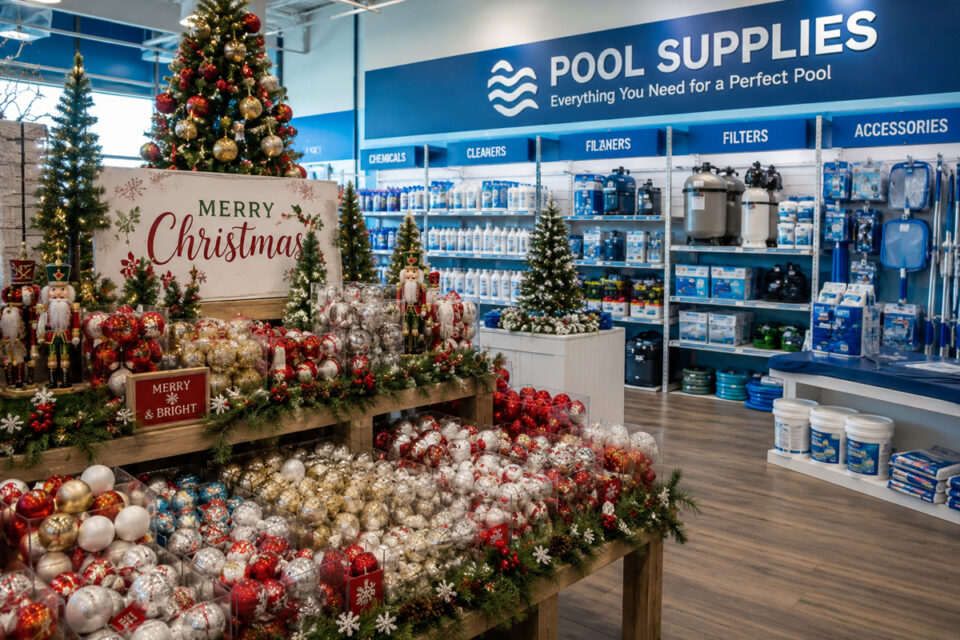
The company’s retail operation also shifts with the seasons. Every October, pool chemicals and supplies give way to ornaments, tabletop décor and holiday displays.
“It’s not a big moneymaker, but it keeps the staff busy over the wintertime,” she says of the retail shift. “It justifies their existence to make sure they’re not bored to tears and that I don’t have to lay off the staff.”
The work also gives technicians a more visible and creative outlet.
“They can show their friends and family the work that they do, where they can’t really do that with the pool industry because they’re in people’s backyards,” she says. “Everybody loves looking at a beautifully decorated home.”
Easing into offseason services
Corey Johnson of Johnson Seasonal Services in Ohio has built a lineup of specialty services designed to keep revenue flowing long after pool season ends. Alongside holiday lighting, the company offers niche services like pumpkin arrangements, knife sharpening and pickup-and-storage services for seasonal décor and household items.
A few years into starting his pool business, Corey decided to offer extra seasonal options to pool customers. The idea for holiday lighting came from his brother, who operates a similar business in Colorado, and Corey saw an opportunity to adapt the concept to his own market.
Still, he cautions pool professionals against adding seasonal offerings without proper planning. Expanding into services like holiday lighting requires training, insurance and dependable employees — especially when crews are working on rooftops or handling potentially dangerous equipment.
“When offering [these] services, we make sure we understand what we’re doing, especially if we haven’t done it before, and we make sure we can do it professionally and safely,” Corey says. “We did training for anything that involved risk — especially knife sharpening.”
Before launching holiday light installations, Corey traveled to Kentucky for hands-on safety training focused on harnesses, anchors and rooftop best practices.
“It’s dangerous work,” he adds.
As demand for seasonal offerings expanded, Corey says inventory storage quickly became an operational challenge. Rapid demand for holiday lighting and related services forced the company to secure warehouse space sooner than expected — a process complicated by lease negotiations and the need for additional financing for equipment purchases.
“If you’re starting offseason work and [want to] grow sustainably and also have that work-life balance, [it’s all about] preparation, preparation, preparation — way ahead of time,” he says. “If you’re starting, start it slow. Build into it. Jumping right in, you come across so many things that you may not have expected, and then it sets you back. That’s when you start getting the burnout.”
Marketing seasonal services
For many companies, existing pool customers are the easiest entry point into offseason offerings. Rather than heavily advertising to the general public, some pool professionals market those services through invoices, email newsletters, social media and service reminders.
Ace Pool & Spa primarily markets holiday lighting to existing customers before expanding outward through referrals and neighborhood visibility.
“We just sent an email out to all customers,” Alex says, noting that word-of-mouth and highly visible installs often generate additional interest from nearby homeowners.
Social media has also become an increasingly valuable tool for seasonal marketing, especially for visually driven services like holiday lighting and décor. Alex says his team stays active on Facebook, Instagram and TikTok throughout the offseason, while also keeping seasonal offerings displayed on the company website.
That type of visibility can create a ripple effect. A holiday lighting project in one neighborhood often leads to inquiries from nearby homeowners, while existing pool customers already have an established level of trust, he says.
Newbie challenges and operational risks
For pool companies, one of the biggest operational hurdles is timing. Peak pool closing season often overlaps with peak holiday lighting demand, requiring a careful balance of scheduling, staffing and workflow.
To offset scheduling conflicts, Ace Pool & Spa incentivizes customers to schedule services earlier. Customers willing to close their pools as early as October may receive discounts, helping free up crews before the holiday rush begins.
The company also offers seasonal promotions during slower winter months, including discounts on high-efficiency equipment upgrades completed in January. Early scheduling and winter upgrade promotions help extend workflow beyond the holidays while keeping crews productive during traditionally slower months.
Still, Alex says, the first year of adding a seasonal service can be “total chaos.” Plus, he adds, holiday lighting comes with a steep learning curve. Unlike pools, where installation and service times are highly predictable, holiday lighting projects proved far more difficult to estimate.
“We had no idea how to quote install time,” Alex admits. “With pools, we had it down to a formula.”
The company initially underestimated everything from labor hours to inventory needs. Alex says the team often misquoted jobs while simultaneously investing heavily in lights and equipment before fully understanding demand.
“Growth is easy. Growing profitably is really hard,” he says, noting now he has a spreadsheet for scheduling and quoting light installs.
Inventory alone can represent a significant upfront investment. Alex estimates his company purchased roughly $10,000 worth of lighting inventory during its early expansion into holiday installs, which carried no guarantee of immediate return.
But unlike pool chemicals, seasonal décor inventory can often be reused for years, creating additional long-term value after the initial investment.
Both Alex and Bond emphasize that patience is critical during the early stages of diversification.
“Go in knowing the first year is a learning experience,” Alex says.
Bond agrees that profitability often comes later, once systems, pricing structures and installation processes are refined. She adds that replacing items comes at a cost, but high-quality commercial lights and greenery — not ones from a local box store — should last up to six years.
While the first season may involve trial and error, repeat customers and reusable inventory can dramatically improve margins in subsequent years.
Keeping afloat year-round
For pool pros who have bridged the quiet seasons between pool time and winter months, it’s a busy time of shifting gears to keep everyone productive and on the payroll.
What once served as a way to survive the slow season is increasingly becoming a strategic extension of the modern pool business — one designed to keep employees engaged, customers connected and revenue flowing year-round.
Alex says adding new services requires equal parts preparation, adaptability and what he jokingly calls “delusional optimism.”
“Every new service is scary because you don’t know anything about it, and I am an expert at one thing: pools,” he says. “I compensate for my lack of ability by extreme action and knowledge.”
Alex recalls selling his first holiday lighting installation before fully understanding the logistics behind it.
“I didn’t know how to do my first lights install when I sold my first lights install,” he says. “I Googled it and watched videos for like 20 hours.”
Alex believes imperfect action is the best teacher for any entrepreneur.
“My goal is just action,” he says. “Ready, fire, aim, is how I do things.”