
The Social History of Swimming Pools
Historian Jeff Wiltse discusses how public pools shaped communities, recreation and access to swimming
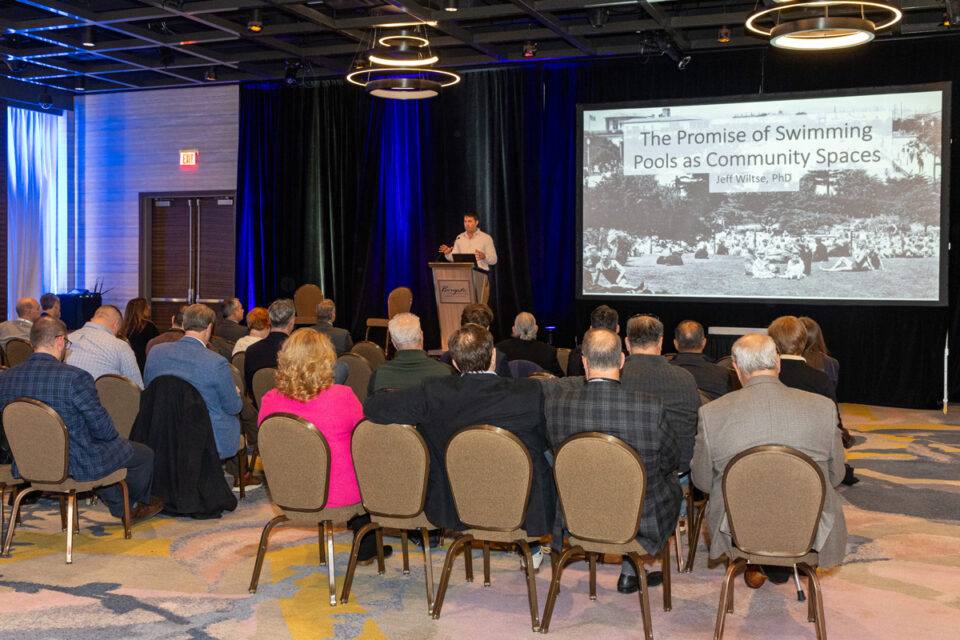
Swimming pools are often discussed in terms of construction, maintenance or recreation, but to historian Jeff Wiltse, the social infrastructure is just as important.
Speaking at the Pool Horizons Summit held alongside The Pool & Spa Show in Atlantic City earlier this year, Wiltse explored how public pools shaped American community life during the early 20th century — and how the legacy of exclusion from those spaces still affects swimming access and drowning disparities today. “Jeff was a very intentional choice,” says Christopher Pound, coordinator at Pool Horizons. “Pool Horizons is fundamentally about understanding and articulating the value of swimming pools in society, and Jeff brings a unique perspective to that conversation. As a historian, he steps outside the industry and helps us see pools not just as products or facilities, but as social and civic spaces.”
Central to the summit was the question of how to better understand, measure and explain the value of swimming pools, Pound says. That includes looking at how to make pools more inclusive, especially with a history of exclusion.
“I grew up swimming and playing at a suburban swim club and intuitively recognized that it was a uniquely social space,” says Wiltse, professor and chair at the Department of History at the University of Montana, Missoula. “In graduate school, I was trying to come up with a good research topic for my dissertation and woke up in the middle of the night dreaming about researching the history of this pool I swam at as a child.”
He recognized that pools are intimate and sociable spaces that likely had a fascinating history, and as he explored the subject further, that proved to be correct.
“Swimming pools are social gathering spaces,” Wiltse says. “In many places, they are the center of summertime community life.”
The ‘swimming pool age’
Wiltse describes the 1920s and 1930s as the nation’s “swimming pool age,” when cities and the federal government funded thousands of public pools nationwide. Many were designed more like leisure resorts than simple recreation facilities, featuring grassy lawns, sandy beaches and sun decks.
“It was during this period that city officials first allowed males and females to swim together,” he says. “Previously, public pools were gender segregated. Gender integration and the shrinking size of swimsuits created a sexually charged atmosphere at pools and made them very popular.”
At the time, swimming at a public pool rivaled moviegoing as one of the country’s most popular recreational activities.
“In all these ways, the interwar years were a transformative period on the history of swimming pools in the United States,” he says. “People spend hours, sometimes the entire day, at pools — swimming, splashing, flirting, talking and people watching. The flip side, though, is that when individuals or groups of people are excluded from a pool, they are excluded from the community and clearly defined as social ‘others.’”
A legacy of exclusion
In cities like Chicago, Pittsburgh and St. Louis, Black and white residents had previously swum together at public pools. But as cities began allowing men and women to swim together during the early 20th century, public pools increasingly became viewed as social and recreational gathering spaces rather than strictly utilitarian facilities.
Wiltse says that shift intensified racial tensions at many pools, leading numerous cities to segregate public swimming facilities or exclude Black swimmers altogether.
“Racial segregation and exclusion at public swimming pools in the past casts a long shadow,” Wiltse says. “It is a large part of the reason why Black Americans today are much less likely to know how to swim than whites and much more likely to drown.”
Wiltse says many Black children were historically denied access to supervised pools and instead swam in far more dangerous natural waterways.
Swimming, as a sport and recreational activity, is often passed down from generation to generation, he adds.
“Black Americans were largely denied access to the pools at which swimming became popularized during the 20th century: first at the resortlike public pools of the 1920s and 1930s and then the suburban club pools of the 1950s and 1960s,” Wiltse says.
Today, many pools remain socially uniform spaces, Wiltse says, with swimmers often coming from similar social and economic backgrounds.
“This results partly from the socially segregated character of many American communities and the trend towards privatization, which tends to segregate pool use along class lines,” he says. “Over the past 60 years, the investment in private pools and the relative disinvestment in public pools has created a class-based swimming disparity in the United States.”
Pools and public health
Decades of reduced investment in public pools have shifted swimming access increasingly toward private facilities, Wiltse says. To change this, he suggests governments prioritize building new and appealing pools in underserved communities and points to initiatives like New York’s NY SWIMS program, which invests in public swimming access and aquatic infrastructure, as a model for expanding access to community pools.
“I would love to see a similar investment today, a time when there is such enormous private wealth in the United States, but without the racial discrimination that marred the earlier effort,” he says, referring to the government push in the 1920s and ’30s for public swimming pools. “We can afford to build a public infrastructure of appealing swimming pools — that is just not how we choose to spend our money.”
Wiltse says swimming pools can also help address modern public health challenges, including obesity, drowning and social isolation.
Drowning is a leading cause of unintentional death worldwide, and supervised community pools provide safer places to learn and practice swimming skills than unsupervised natural waterways.
“Swimming pools are powerful antidotes to social isolation, screen addiction and synthetic interactions,” Wiltse says.
Lessons for the industry
To encourage change in the future, pool operators, builders and communities need to be more intentional about creating inclusive aquatic spaces by focusing on location and affordability, Wiltse says.
Pools need to be located in or near parks, accessible by public transportation and affordable for families to use, he explains.
Pound, of Pool Horizons, says the industry increasingly needs language and evidence that help communicate the larger value of pools beyond just recreation.
Pool professionals often focus on construction, operations and economics, but Wiltse hopes the industry also recognizes the broader civic role pools can play.
“I would like pool professionals to also think and talk about swimming pools as vital social spaces that benefit swimmers and communities in many important ways,” Wiltse says. “Be aware of swimming pools’ enormous potential for good but also be aware of the history of swimming pools in the United States, which shows that there are long-lasting negative consequences for people who do not have access to pools.”
