
Adaptive Circulation
H2Flow’s Nautis pump brings constant flow to residential pools
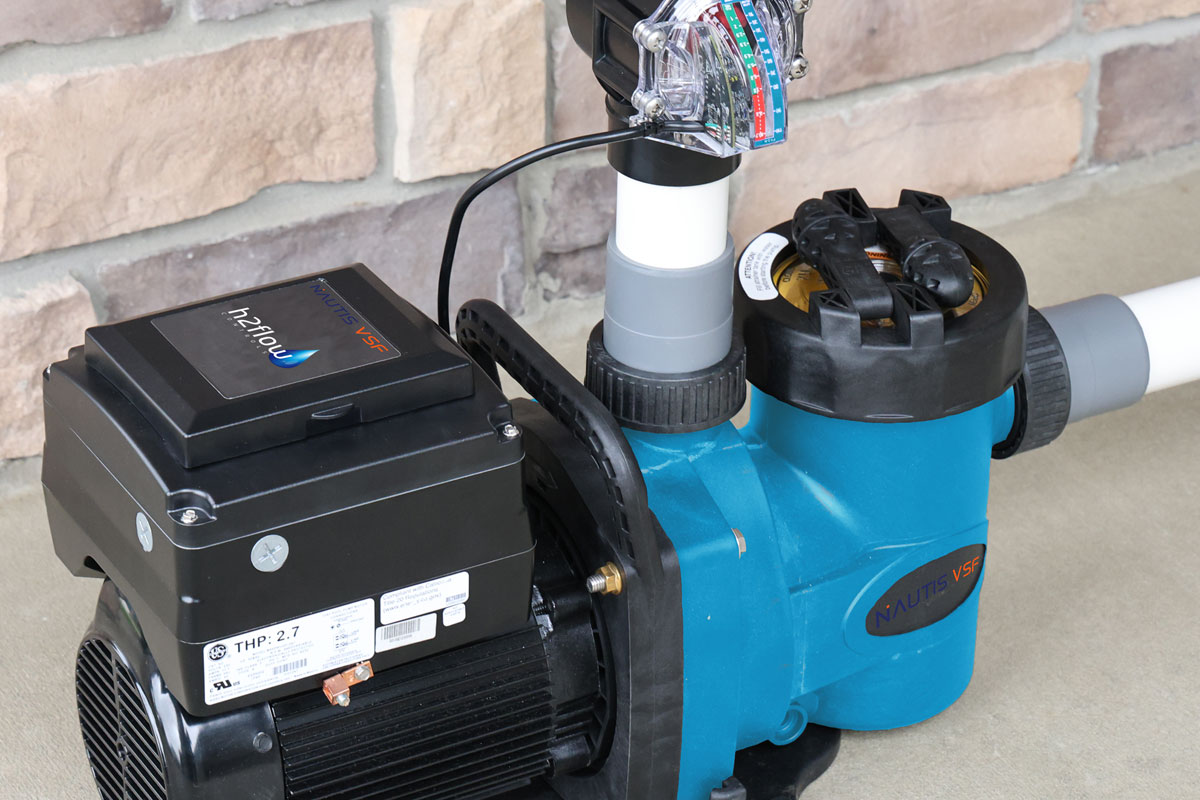
For years, the pool industry has improved energy efficiency through variable-speed pumps. But as pool setups grow more complex — with heaters, water features, cleaning systems and shifting hydraulic conditions — maintaining consistent circulation often still requires manual adjustment.
H2Flow’s new Nautis adaptive-flow pump is designed to change that by shifting the focus from pump speed to flow rate. By automatically adjusting speed to maintain a target flow, it simplifies operation while improving overall hydraulic performance in residential pools.
Rethinking variable-speed operation
Variable-speed pumps have delivered major efficiency gains, but consistent circulation can still be difficult to maintain.
“In real-world pool systems, conditions are constantly shifting — filters load up, valves are adjusted, heaters cycle on and off and plumbing restrictions vary,” says Gavin Hackett, president of H2Flow. “A pump set to a fixed speed rarely delivers consistent hydraulic performance over time.”
That challenge led to the development of Nautis.
“With the Nautis platform, we focused on an adaptive, constant-flow approach that allows the pump to respond automatically to changing conditions and maintain a target flow rate,” Hackett says. “Rather than the operator chasing the right RPM setting, the pump continuously optimizes itself.”
The concept builds on technology H2Flow has long used in commercial environments, where circulation must meet strict turnover requirements. For Nautis, H2Flow paired its flow-sensing and control technology with a Speck pump to create a fully integrated adaptive-flow solution.
“It’s something we’ve already been doing with our Eco-Flow variable-frequency drives in conjunction with FlowVis and FlowVis Digital,” says Sean McDermott, executive vice president at H2Flow.
In commercial pools and spas, maintaining those turnover rates is essential for water quality and compliance. Constant-flow operation ensures targets are met regardless of filter loading, valve changes or added features.
As variable-speed pumps became standard in residential pools, H2Flow saw an opportunity to bring that same approach to the backyard.
Flow-based control
The key change is moving away from RPM as the primary control point.
McDermott says flow is a more meaningful measure of circulation than RPM.
“The speed that the shaft of the motor is turning is really irrelevant to pool maintenance,” he says. “Being able to calculate turnover rate and run at a constant rate — or simply set a constant flow — solves a lot of issues.”
Flow is measured directly using H2Flow’s FlowVis technology rather than being estimated from motor performance.
“With FlowVis and FlowVis Digital, we’re less than 2% off,” McDermott says.
The pump platform also includes features to optimize performance and protect equipment. Users can schedule higher-flow “boost” periods, set flow rates for in-floor cleaning systems and get alerts when blockages or heavily loaded filters are detected.
It can also protect heaters by automatically increasing flow during operation.
“It ensures the pump is always running at the most efficient point necessary to maintain the desired flow, which translates into energy savings and more predictable performance,” Hackett says.
Insufficient flow can sometimes cause heaters to overheat — an issue service technicians occasionally encounter.
“Your heater essentially turns into a gas grill,” McDermott says.
To prevent that, flow increases when the heater is running.
“When the heater turns on, we ramp up to 50 gallons per minute,” McDermott says. “After reaching temperature, we keep that flow for about three minutes to cool the heater, then return to normal operation.”
At a glance: Nautis VSF Pump
Type: Variable-speed + adaptive-flow pool pump
Key technology: Eco-Flow adaptive flow control
Core function: Maintains a constant gallons-perminute flow rate rather than fixed RPM
Automation: BlueSync mobile app connectivity
Installation: Drop-in replacement for several common pumps
Pipe compatibility: 2-inch FlowVis flow meter included
Available sizes: 1.65 THP, 2.25 THP, 2.7 THP, 3.45 THP
Certifications: EnergyStar models available; NSF/ANSI 50 compliant
See the Nautis Pump in action: youtube.com/watch?v=A_-kYpVKtWU
Benefits for service professionals
For pool service companies managing multiple accounts, maintaining proper circulation often becomes trial and error as conditions change — from filter loading to plumbing adjustments to additional equipment coming online.
“Technology that simplifies operation while improving performance is one of the biggest opportunities we have to support service professionals,” Hackett says. “Technicians spend a significant amount of time trying to achieve proper circulation.”
By allowing technicians to set a target flow instead of guessing at RPM, Nautis is designed to remove much of that guesswork.
“As conditions change, the pump adjusts automatically to maintain that flow,” Hackett says. “For service professionals, that means fewer callbacks and more reliable operation.”
For homeowners, McDermott says the value is straightforward.
“The main idea behind Nautis is to optimally operate your pool for electrical efficiency, safety and equipment protection,” McDermott says. “It’s saving you money across the entire system — from the equipment to the condition of the water.”
Looking toward smarter pool systems
The Nautis pump reflects H2Flow’s broader strategy of improving how circulation systems are monitored and managed.
“For years, our products have focused on giving operators better visibility into flow and performance through accurate sensing,” Hackett says. “Nautis takes the next step by using that data to actively control circulation.”
As sensors, pumps and automation platforms evolve, Hackett expects more integrated water management.
“We see circulation, monitoring and automation becoming increasingly connected,” he says. “Pumps, sensors and control platforms will work together to give pool professionals clearer insights and greater control.”
H2Flow is already developing technologies that extend that concept, including an algae detection system designed to identify early signs of growth before problems become visible.
“We see the industry moving toward smarter, more proactive water management,” Hackett says. “It’s a shift from reacting to problems to identifying early indicators and addressing them before they impact water quality.”
By combining sensing, monitoring and intelligent equipment, he says, water conditions can be managed more consistently with less manual intervention.


