Mastering Motivation
How autonomy, mastery and purpose lead to success
Key Concept: Motivation
Aspects of personal and professional achievement, which I call Key Concepts, are essential to driving effective behavior in work and life. These concepts are connected; it’s never just one thing.
Sustainability involves developing skills that foster long-term personal and professional productivity, and motivation is connected to any sustainable long-term success.
There are two types of motivation, but only one is sustainable.
- Extrinsic motivation — an inspiring TED talk or keynote speech, the threat of being fired or losing money or a relationship — is something outside of ourselves driving our actions.
- Intrinsic motivation is an internal drive, fueled by personal satisfaction, to engage in activities for their own sake. It’s the harder of the two to sustain because it’s much easier to let something else impact and take charge of our emotions than to do it ourselves.
Both are important and have their place; however, intrinsic motivation is self-sustaining.
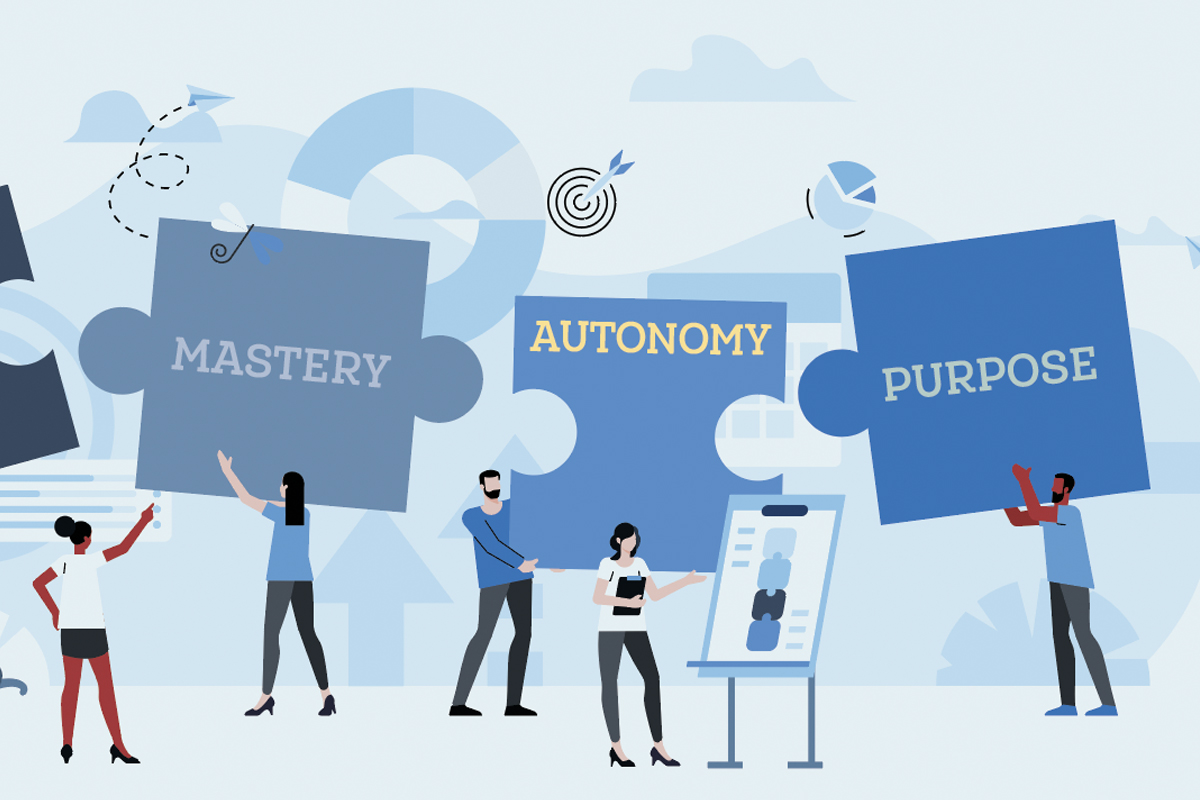
Research has established three components necessary for intrinsic motivation: autonomy, mastery and purpose. Luckily for us, the sales profession can activate them all.
Autonomy
Autonomy is the capacity for self-determination, allowing us to act based on our principles and values rather than external pressures. (Principles and values are our sales process’ cornerstones and key concepts.) Autonomy means taking ownership and responsibility for our decisions and actions, never blaming or making excuses. Never.
Mastery
Mastery refers to a high level of knowledge and skill in a specific subject or activity. In our training, we refer to this as a “virtuoso,” the next to highest level achievable; this is rare but great to behold. (“Levels” of expertise are another key concept of achievement.)
One of the greatest challenges of the sales profession is exemplified in the Dunning-Kruger Effect, which illustrates a cognitive bias in which individuals with limited competence overestimate their abilities. This effect unfolds over stages from initial overconfidence to eventual realistic self-assessment. As 20th-century physicist Richard Feynman notes, “The first principle is that you must not fool yourself — and you are the easiest person to fool.”
Research has established three components necessary for intrinsic motivation: autonomy, mastery and purpose. Luckily for us, the sales profession can activate all of them.”
Note: “Stupid” is defined as a lack of understanding. So the first level after “know nothing” is what we refer to as a “typical salesperson,” something none of us want to be labeled. Confidence does not equal competence.
This is what best-selling author and entrepreneur Seth Godin means when he says 80% of salespeople are below average: We learn enough to get by and then stop, unless we strive for mastery.
Mastery of anything is difficult; it takes diligence, discipline, time and sometimes an entire career to achieve.
Purpose
Purpose is sometimes viewed as a “save the world” effort when it is the intention, aim or function of something serving as the reason behind the actions or even a long-term goal. (Goals are another important Key Concept.)
Purpose can be as simple as getting good at your job. It could also be Tony Robbins providing 1 million meals to disadvantaged people or Effort Today Enterprises offering educational scholarships in Belize. Autonomy and mastery open the door for many definitions. As a sales professional looking to create a successful and sustainable career, understanding and embodying autonomy, mastery and purpose is the ticket to a lifetime of motivation.