Finding the Balance
Understanding phosphates without the myths, marketing or misinformation
Few topics in pool water chemistry generate as much disagreement as phosphates.
Ask five industry professionals how much phosphates matter, and you’re likely to get five different answers.
“As the saying goes, ‘You can’t believe everything the internet says,’ — and the internet says a lot about phosphates,” says Alicia Stephens, director of training and education at BioLab.
Stephens says the abundance of information, much of it unsupported by science, has left many pool professionals and homeowners uncertain about the role phosphates actually play in water quality.
Eric Knight, executive director of Watershape University, says phosphates themselves aren’t especially complicated. Instead, he believes the confusion comes from differing opinions about how much attention they deserve compared to other aspects of water chemistry.
Opinions tend to fall at opposite ends of the spectrum, Knight says. Online homeowner forums and educational sites often argue phosphates don’t matter as long as free chlorine levels are maintained. Meanwhile, some retailers and industry professionals view phosphates as a critical issue that should be kept as close to zero as possible.
Know the basics
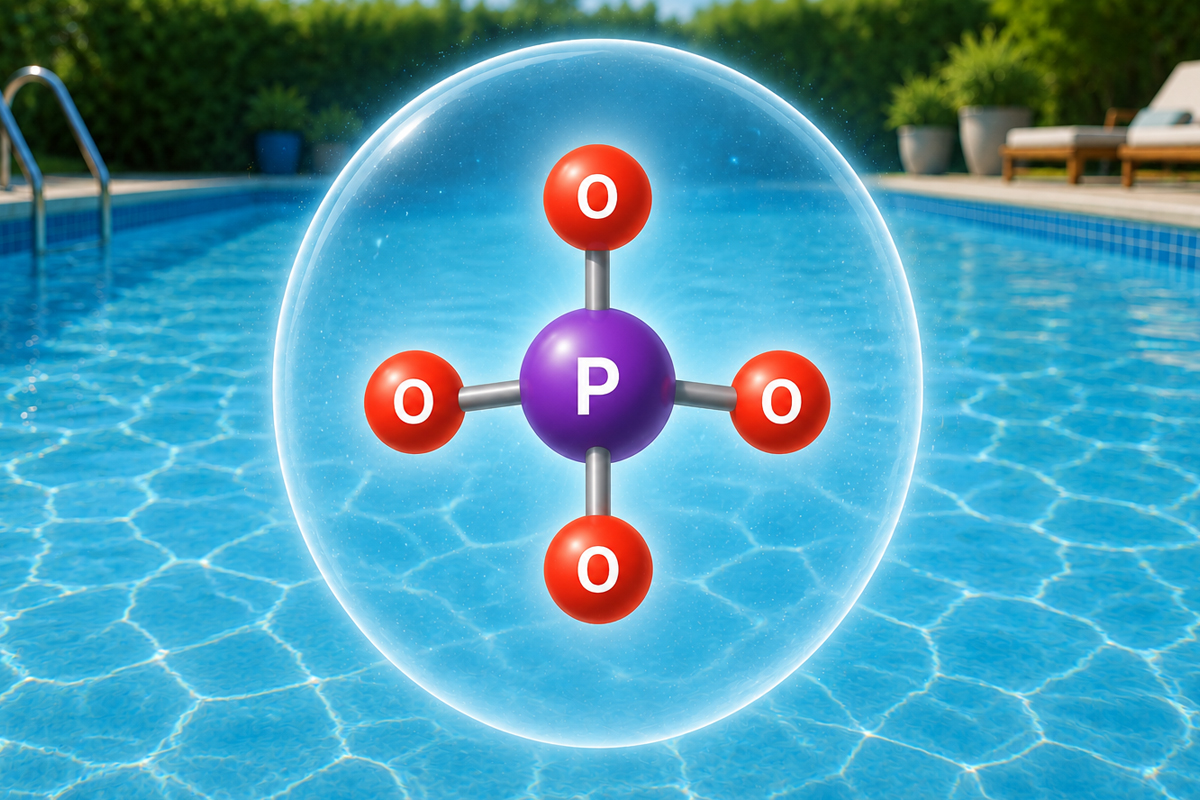
Understanding what phosphates are helps explain why they’ve become one of the industry’s most debated water chemistry topics. The Pool & Hot Tub Alliance Recreational Water Quality Committee defines phosphates as compounds containing phosphorus, an essential nutrient found naturally in the environment. In pools, phosphates are introduced through rain, fertilizers, runoff, leaves and other organic debris, wildlife and even some municipal water supplies.
Because they’re constantly entering the water, phosphates are a normal part of nearly every pool. Their presence alone doesn’t indicate a problem, but higher levels can create conditions that make pools more difficult to maintain.
Separating fact from fiction
Knight believes the debate has become more polarized than the science itself.
Scientific research points to a middle ground. Phosphates serve as a nutrient source for algae, but they don’t create algae on their own or replace the need for proper sanitizer levels. Instead, they become one factor that can make it easier for algae to grow if chlorine levels aren’t maintained.
Phosphates matter, Knight says, but they are often blamed for problems they have nothing to do with — namely calcium flakes in saltwater pools and scaling on salt chlorine generators. These misconceptions are common throughout the industry, particularly around the relationship between phosphates, salt chlorine generators and calcium scaling.
For many veteran service professionals, phosphate testing wasn’t part of routine service. Knight says that’s changed in recent years because phosphate compounds are now often used in municipal water systems to help control corrosion, making phosphates more common in source water.
Priorities first
Pools with elevated phosphate levels can still be clean, clear and properly sanitized. However, higher phosphate levels can make that water harder to maintain and increase the likelihood of algae growth. That’s why Stephens says phosphate management should support — not replace — the fundamentals of pool care.
Maintaining a sanitizer residual is the top priority in any pool or spa.
“Nothing comes above that,” Stephens says.
Balanced pH and alkalinity help sanitizer work efficiently while protecting the pool surface, maintaining water clarity and keeping swimmers comfortable. Circulation is equally important because treatment products can’t work effectively without proper water movement.
Stephens notes that phosphates can also contribute to the formation of calcium phosphate scale and cloudy water. However, this is different from the calcium carbonate scaling and calcium flakes that Knight says are often mistakenly blamed on phosphates.
“While this is not usually a huge problem in pools, it can make overall scaling started by calcium carbonate scale a bigger issue,” she explains.
Stephens says the clearest connection between phosphates and water quality is algae.
Lowering phosphate levels doesn’t starve algae completely because algae can store nutrients for later use. Instead, lower levels slow algae growth, giving sanitizers and algaecides more time to do their job.
Questions homeowners will ask
And how to answer them
“Do phosphates cause algae?” Not directly. Phosphates are a food source, but algae still need favorable conditions to grow
“If my phosphates are high, is my pool unsafe?”
No. A high reading doesn’t necessarily mean there’s a problem if sanitizer and water balance are maintained.
“Should I try to get phosphates
to zero?”
No. Phosphates constantly enter pools from the environment, so zero isn’t a practical long-term goal.
“Why do phosphates keep coming back?”
Rain, wind, fertilizer, leaves, wildlife and fill water continually introduce new phosphates.
Why zero isn’t the goal
While the industry often promotes the idea of a “phosphate-free pool,” that’s simply not realistic.
Knight compares the idea to trying to maintain a dust-free home or a weed-free lawn. New phosphates are constantly entering the pool, making a permanent zero reading impractical.
Even if a pool reaches a zero-phosphate reading, that result is likely to be short-lived.
Phosphate removers are effective, but they don’t provide an ongoing residual. Once the initial removal process is complete, new phosphates entering the pool remain until the next treatment.
Rather than chasing a zero reading, pool professionals should focus on keeping phosphate levels reasonably low — generally below 500 ppb, Knight says. If phosphate levels rise despite treatment, the next step isn’t adding more remover. Instead, investigate the source, whether it’s runoff, fill water, nearby landscaping or something else.
“Any pool pro should be able to attain this [level] on most pools, and for those problematic pools where phosphates rise rapidly, do some investigating to find out why, and address the source,” Knight says.
Putting results in context
Stephens says phosphate test results should be viewed as one diagnostic tool rather than a stand-alone indicator of pool health.
A high reading doesn’t automatically mean a pool is about to develop algae, nor does a low reading guarantee problems won’t occur. Results should always be evaluated alongside sanitizer levels, water balance and the pool’s overall condition.
That also means helping homeowners understand what phosphate test results actually mean. A high phosphate reading shouldn’t create unnecessary alarm, but it also shouldn’t be ignored. Explaining where phosphates come from and how they fit into overall water chemistry can help customers make informed decisions.
“Emphasize the importance of sanitizing, oxidizing and preventative algaecides, as well as water balance, and include phosphate testing as part of the water balance discussion,” Stephens says. “It’s just one element of pool care.”