Water Chemistry in High-use Summer Pools
What the numbers are really telling you
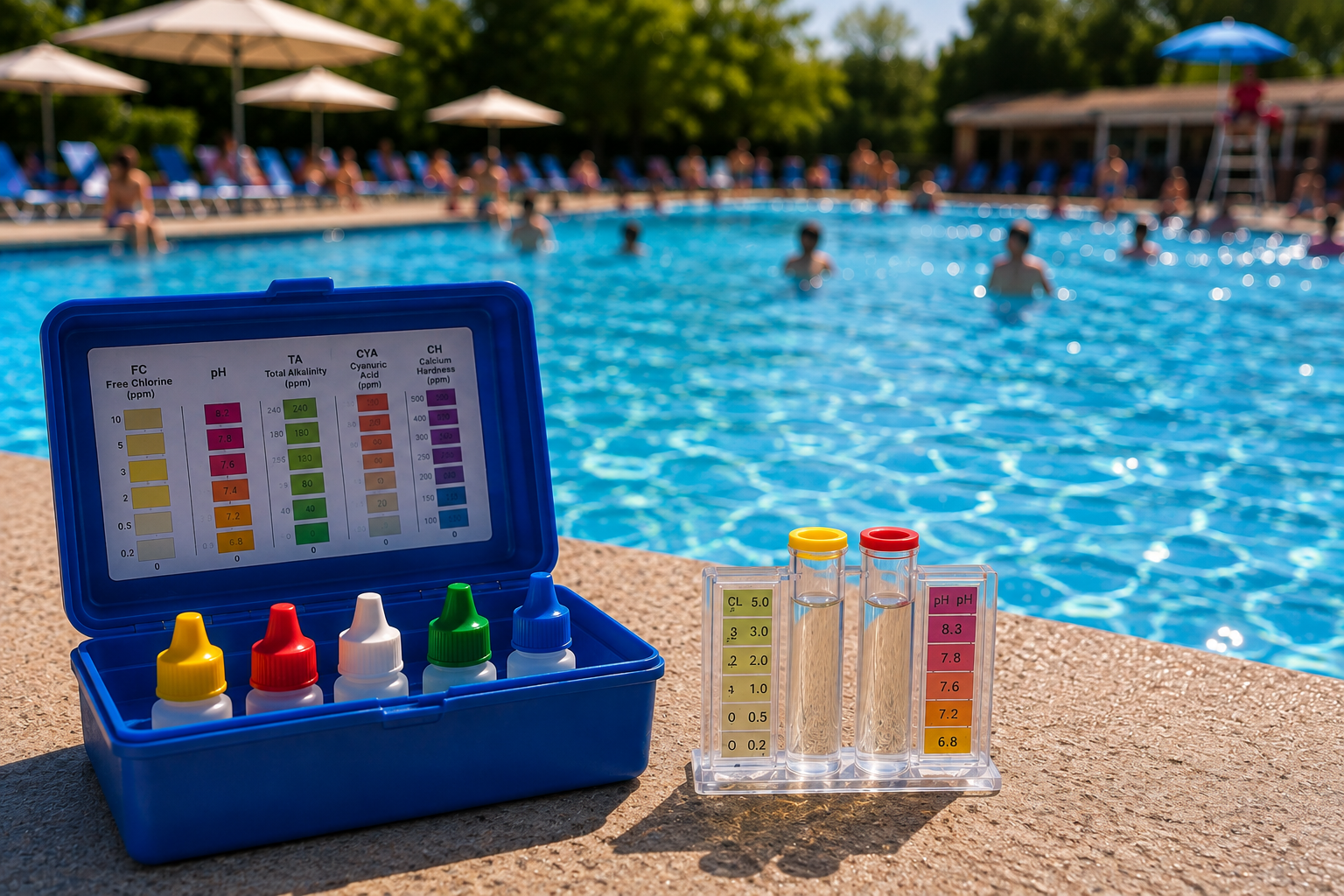
A pool in peak summer is a system under pressure. It’s like a commercial kitchen at the peak dinner rush or he airport during the holidays. Bather loads climb. UV intensity accelerates chlorine depletion faster than in any other season. Water temperature sits at the upper edge of the comfortable range, which means demand on every chemical parameter increases simultaneously.
Every reading on a test strip or digital reader carries more information than the number itself, including what’s happened since the last visit, what’s happening right now and what the pool will do next without expert intervention.
Reading that story accurately is what separates a technician from a professional.
When summer changes the rules
The chemistry approach that worked through April and May won’t hold up the same way in July and August.
Heat accelerates almost all the challenges in pool management. Chlorine burns off faster, algae growth conditions improve, scaling is more prevalent and organic load from sunscreen, sweat and body oils accumulates more aggressively as the pool gets thoroughly enjoyed. A pool that needed a light touch in the spring can demand daily attention by the first real heat wave of the summer.
Cyanuric acid offers a useful illustration of how summer shifts the calculus. Stabilizer protects chlorine from UV degradation, which makes it a logical tool for outdoor pools. But as CYA climbs — through repeated chemical additions or concentrated splash-out — the effective power of free chlorine drops, even when the FC reading looks adequate. At 80 ppm CYA, a free chlorine level of 3 ppm behaves more like 0.3 ppm in terms of actual sanitizing power.
Experienced technicians watch the CYA-to-FC ratio as closely as the individual numbers, if not more so. We favor multiple forms of chlorine over CYA-only tablets. It’s a small technical choice, but it’s where care actually shows up: less downtime, less water waste and lower costs for the client down the line.
Free chlorine tells you more than cleanliness
A free chlorine reading is an efficiency indicator as much as a safety one. When FC drops faster than expected between visits, that’s data you can’t ignore. It points toward elevated bather load, a CYA problem, a circulation issue or organic contamination that the system is actively fighting.
Chasing FC back into range without identifying the underlying cause is treating the symptom, not the disease.
Combined chlorine — the difference between total and free — adds another layer. A combined chlorine reading above 0.2 ppm indicates that chloramines are present, the compounds responsible for the familiar “pool smell” that uninformed homeowners often misread as a sign of too much chlorine. In reality, it usually signals too little effective chlorine reacting with too much nitrogen-bearing waste. A breakpoint chlorination event addresses the chemistry; explaining what caused it is part of the professional’s job, too. Chloramines typically tell the story of reactive pool care, rather than proactive.
Why pH rarely holds still in summer
Summer pools tend to drift alkaline. Carbon dioxide off-gasses more readily in warm, aerated water, and that outgassing pulls pH upward. High bather loads contribute additional nitrogen and other compounds that further disrupt the carbonate equilibrium. Left unchecked, elevated pH reduces chlorine’s sanitizing efficiency and encourages scale formation on surfaces, tile and equipment.
Total alkalinity functions as the buffer that controls how readily pH moves. TA that runs too low makes pH erratic and difficult to manage, as small chemical additions produce large swings. Too high, and pH becomes stubbornly resistant to correction and tends to climb. In high- use summer conditions, the relationship between TA and pH requires more frequent calibration than it does in quieter months.
Calcium hardness and the surfaces at stake
Calcium hardness operates on a slower timeline but carries consequences that accumulate over seasons, not visits. Water that runs too soft (below roughly 200 ppm) becomes aggressive, seeking calcium from available surfaces, which means plaster, grout and tile. Water that runs too hard deposits scale. In summer, evaporation concentrates calcium and other dissolved solids faster than in cooler months, which means a pool that tested within range in June may read elevated by August without any direct addition.
The Langelier Saturation Index gives technicians a composite view of how these variables interact — pH, TA, calcium hardness and temperature together determine whether water is corrosive, balanced or scaling. No single number tells the whole story.
What experienced technicians are actually doing
In peak summer, every service call is first and foremost a diagnostic. Water chemistry in high- use summer conditions is in constant motion, and the numbers at any given moment reflect dynamic changes. Technicians who approach visits with that framing — reading conditions, identifying trends, anticipating what the next week will bring — are the ones who keep pools out of crisis.
The homeowner rarely sees that work if we do it well. It’s the Swan Effect: above the surface, it looks graceful, simple and smooth; but underneath the water, there’s a whole lot of invisible paddling and effort. Clients see the result of it: water that’s ready before they even ask, looks welcoming, feels comfortable and safe and doesn’t produce the problems that make them question whether professional service is actually worth what they’re paying. That confidence doesn’t come from the chemicals. It comes from the judgment and care of the technicians behind them.