Plaster Pros
Why the mixer is key to the perfect pool install process
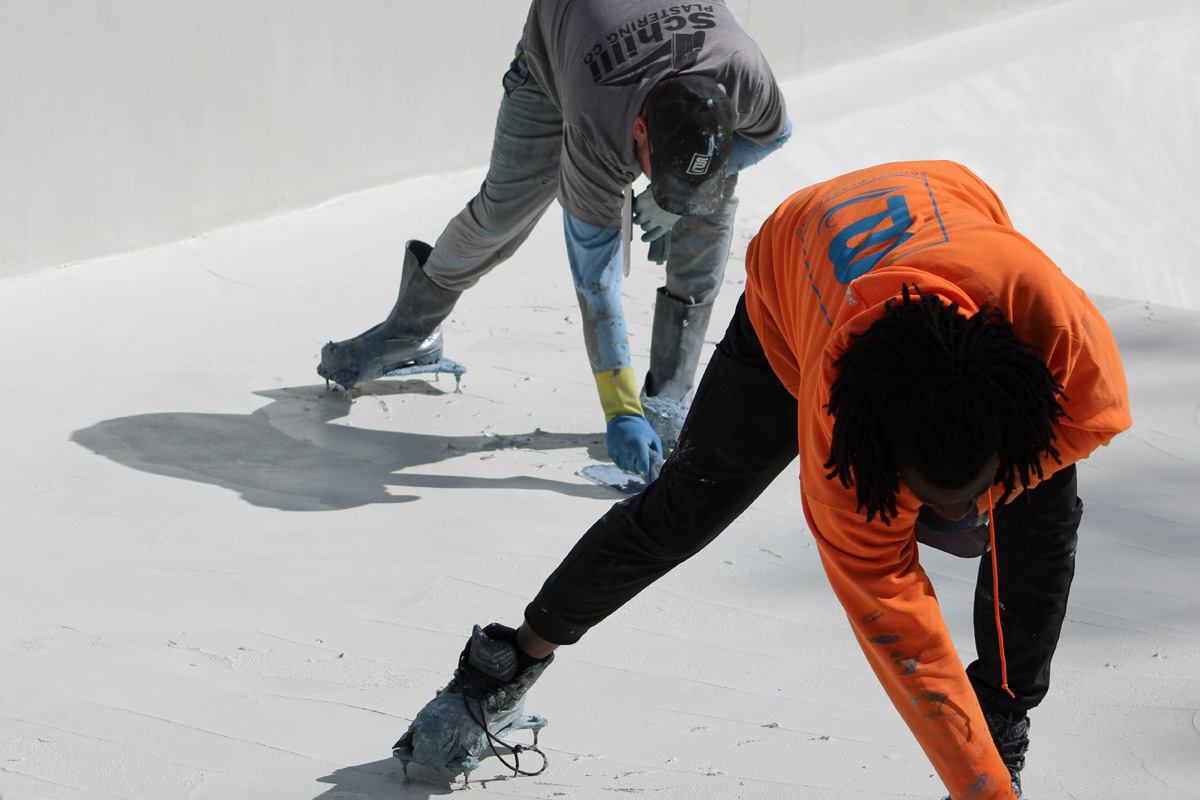
Pool plastering has always been part art, part science and a whole lot of patience.
Ask the mixer on any plaster crew, and they’ll explain their ratios are followed as closely as a grandmother’s secret cookie recipe — precise and based on experience as much as measurement.
But unlike baking, the recipe hasn’t stayed the same. Over time, new surface options and additives have changed how plaster is mixed and finished. Today’s plaster isn’t just white cement — it’s a customized finish designed for aesthetics and longevity.
That’s why experts say the mixer is the most important person on the crew.
“All your successes or failures depend on the guy who’s on the back of the truck,” says Shaun Goldberg, manager of Burkett’s Pool Plastering based in California.
The evolution of pool plaster
Decades ago, most pools were finished with a simple white cement and silica sand blend. But as client expectations shifted toward texture, color and long-term durability, new options emerged — quartz, mini pebble, polished finishes and blends enhanced with polymers or pozzolans.
Dave Schilli, CEO of Schilli Plastering Co. in Missouri, recalls the transition firsthand. By the mid-1980s, aggregate finishes were gaining traction. Equipment changed, too.
“Plaster mixers and wheel barrels gave way to plaster rig trucks with everything mounted right there on the truck,” Schilli says.
Yet one thing hasn’t changed: the significance of the mixer’s judgment. Today’s products are prebagged, preweighed and often include multiple components, but understanding how they come together still depends on the person controlling the batch.
“The mixer man has to put in the proper amount of material and water in the proper sequence,” explains Goldberg, who also serves as the chairman of the National Plasterers Council board. “Now the pigments are normally premeasured and preweighed in water-soluble bags. In the old days, we had black and blue dye and used a 7-Eleven cup to measure with. Now you have all these different colors. You can also have different pebble colors, glass aggregates, quartz, abalone and admixtures in a batch. It takes more thought and training to get it right.”
For crews that do custom mixing on-site, it’s critical to have backups if the main mixer person is unavailable.
Because Goldberg holds the mixer person in such high regard, his company pays them accordingly to keep them in the position, while also cross-training the rest of the crew, ensuring the operation doesn’t stall if the primary mixer is unavailable.
The mixer man can make or break you. Everybody’s success starts in the mixer.”
Shaun Goldberg, Burkett’s Pool Plastering
“Train and educate yourself and your crews,” he says. “To master the mix, train your mixer man to be consistent. Pay them what they are worth so they want to stay, because once you find a good one, you need to keep them. The mixer man can make or break you. It all starts with their uniformity. Everybody’s success starts in the mixer.”
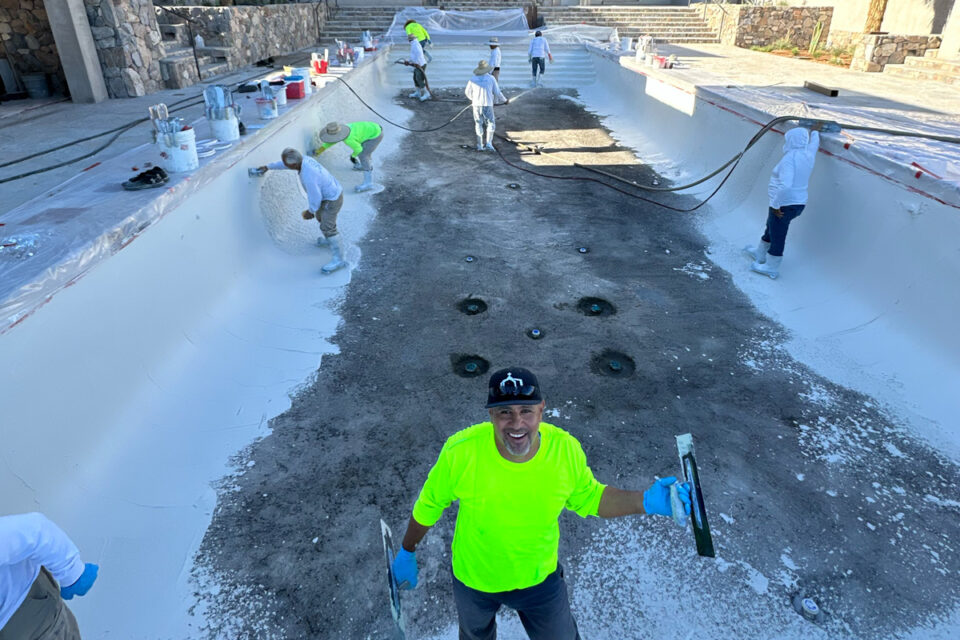
Understanding the mix
The foundation of every finish is the chemistry and consistency of the mix.
At its core: cement, aggregates and water. Admixtures can improve strength, pumpability, workability and durability, too.
“Mix ratios usually consist of one part cement to 1 1/2 to two parts aggregate,” Goldberg says. “Pebble finishes can be one part cement to one part pebble aggregate. Quartz products typically have a higher aggregate ratio than pebble finishes.”
Material selection also matters, and preferences tend to hold firm.
“Most crews do not like change,” he says. “Once you are used to the way a cement performs, it can be difficult to change. My advice is to use material from a quality manufacturer and to stick with it.”
As for aggregate, size influences both density and aesthetics and will depend on client wishes.
Above all, Goldberg says following manufacturer guidelines ensures plaster is mixed correctly. “It is very important to understand how [the manufacturers] want their material mixed and applied. Warranties depend on it,” he says. “The NPC acknowledges the importance of manufacturers’ specifications when you are applying that product.”
Preparation begins before the truck rolls out
Flawless pool finishes depend on choices — crew leadership and the actual product — made long before plaster day.
Jay Eaton, owner of Cal Plastering Co., based in Arizona, emphasizes the importance of collaborating with reputable pool builders from the beginning to reduce bonding issues. Structural problems will cause issues even for a solid plaster job.
When Eaton’s crew arrives, the ideal site is organized, and yard debris is nonexistent — no leaves or pool inflatables that might take flight and land amid a pool shoot. Before rolling out, Eaton’s crews do a full truck inventory. With more than 250 color combinations, having the right materials on board is essential to starting on time.
“We have so many different combinations of things,” Eaton says. “You have to have the right formula, you have to know what the formula is and you have to load the material accordingly before the truck leaves.”
The perfect mix
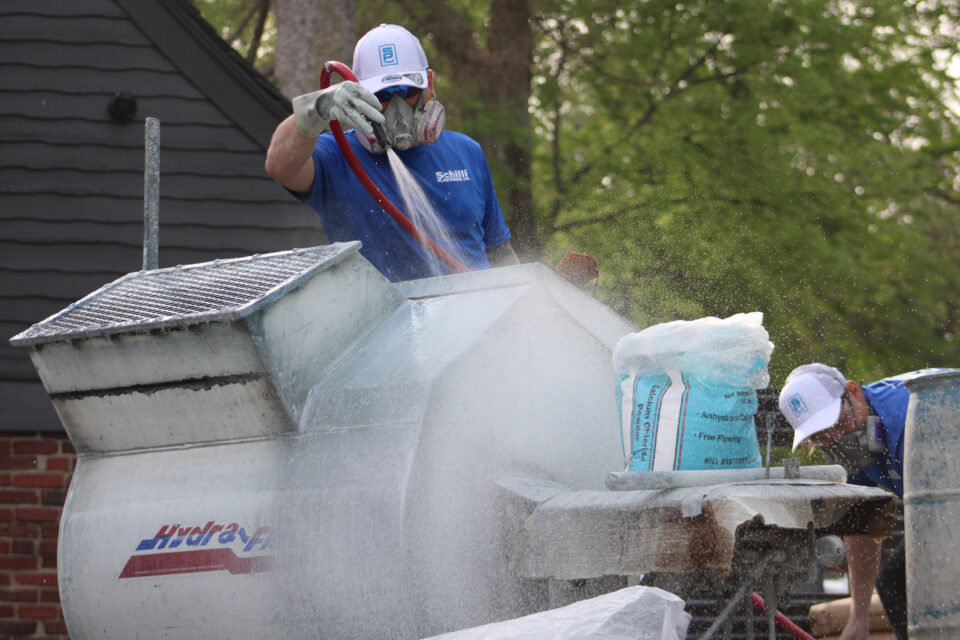
When Goldberg’s crew mixes, he prefers a thicker batch with a lower water-to-cement ratio to produce a stronger product. His crew also follows a consistent sequence: two-thirds water in the mixer, then adding pigment and additives, a third of aggregate, all the cement, the remaining aggregate and then water to hit the ideal mix.
Proper mix time is everything, he says.
“Adding the proper components in the proper sequence is big because that’s made specifically so it’s integrally mixed and blended,” Goldberg says. “If you throw all the cement in without any aggregate at all, it clumps. It’s important to add some of that aggregate first — it’s helping to mix itself. Allowing three to five minutes for the batch to mix after all components have been added is hugely important.”
Adding too much water can shorten plaster lifespan, while uneven pigment can show up instantly.
As with most pool pro work, hands-on training is often the best way to discover good plaster practices.
While Schilli recommends the NPC’s Technical Manual 4.0 — particularly section 4.1 on batching and mixing procedures — he says, “it still comes down to knowing how the material should look as it is being mixed and prepared to be dumped into the hopper to be sprayed onto the pool shell.”
He adds, “[Mixers] learn through experience what it takes to reach the consistency that allows plasterers to properly pump, place, trowel and achieve the desired results prior to the final set of the materials.”
Prepare for anything
Most plaster crews have at least one horror story. For Jay Eaton, owner of Cal Plastering Co., it came nearly 20 years ago, right before Memorial Day weekend, when his team was shooting a pool in a busy construction neighborhood. At the exact moment a nearby landscaping contractor drove past the jobsite on his final round before vacation, the cement truck hose broke at the manifold — blasting plaster straight through his open window and into his face. The good news: He was fine.
“[Reality set in when] he took his week-old truck into the dealer and we spent $11,000 fixing the truck,” Eaton says. “We had to replace the chrome trim and the bumpers and repaint the truck.”
The takeaway? “Own it and then try to prevent it,” he says.
Plastering, Eaton notes, can be unpredictable work — and that’s why a skilled, coordinated mixing crew is essential. Whether avoiding costly mishaps or achieving a flawless finish, he says the crew behind the mix can make or break the final result.
Start-up determines longevity
Even the best plaster job can fail if the start-up is mishandled.
“Finish issues are not going to be related to mixing as much as they would be to start-up and/or maintenance,” Schilli says.
Eaton adds that darker finishes tend to highlight imperfections more readily, making proper water balance even more critical. Regardless of finish type, consistent water chemistry and early care ultimately determine how the surface holds up over time.

Fixing the failures
If the mixer and plaster crew have been trained on proper manufacturer application techniques and are consistent, a plaster job shouldn’t fail.
That’s why working with a well-established manufacturer — and adhering to strict guidelines — can help significantly if a customer has an issue down the line.
Cracks, which often aren’t seen until a pool is drained, are a common customer complaint. Luckily, closed shrinkage cracks are considered a cosmetic issue. However, open shrinkage-related cracks happen during the drying and setting process and require “remedial work,” according to the NPC.
Most finishes come with warranties; Schilli says his company provides a minimum one-year warranty and a five-year warranty on aggregate finishes. In his experience, it’s rarely a pool plastering issue that’s the root cause.
“Depending on the issue, if it is a complete failure of the surface, we would probably redo the entire pool,” he admits. “Product issues sometimes come into play, and generally, the manufacturer will work with us to resolve the issue. But again, there really is no way that a mix problem is going to cause a finish to fail, at least not that I have ever dealt with in my 50 years of pool plastering.”